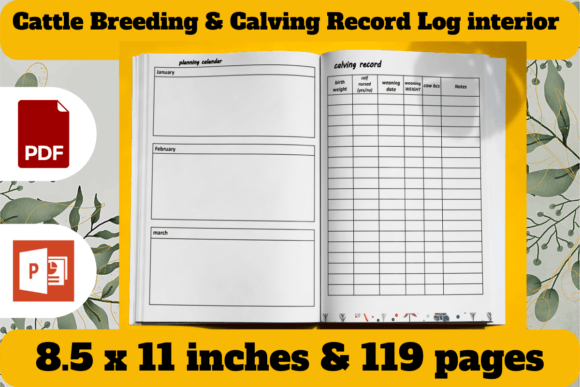
The Cattle Breeding Calving Record Log: A Vital Tool
Whether you manage a small hobby farm or a large commercial herd, the act of breeding cattle and recording calving events is a fundamental part of your operation. It’s a cycle of planning, anticipation, and critical observation. Yet, the sheer volume of details—breeding dates, sire information, health observations, birth weights, and post-calving progress—can quickly overwhelm even the most organized mind. This is where a dedicated Cattle Breeding Calving Record Log transforms chaos into clarity. It’s more than a notepad; it’s a systematic framework designed to capture every essential data point in one permanent, accessible place.
Why This Log Matters to Different People
The value of a precise calving record is universal, but the reasons for prioritizing it can vary dramatically depending on your role and goals.
A beginner or hobbyist might see it primarily as a learning tool and a memory aid. For someone with a few animals, the log helps establish good practices from the start. It turns the complex process into a manageable checklist, ensuring they track the basics like gestation length and calf vitality. The act of filling out the log reinforces learning and creates a personal history of their herd’s development.
For the professional rancher or commercial business owner, the log is a cornerstone of operational efficiency and financial planning. Here, data directly impacts profitability. Accurate records allow for analysis of breeding success rates, sire performance, and genetic trends. They inform culling decisions, help predict feed requirements, and are indispensable for veterinary care and health certification. In this context, the log is a business document, its reliability affecting everything from insurance claims to market reputation.
Educators and extension agents may evaluate the log differently, focusing on its structure and educational value. They might use it as a template to teach best practices in animal husbandry, demonstrating how systematic data collection leads to better management decisions. The clarity of its layout and the comprehensiveness of its entries are key.
Evaluating the Right Tool for Your Needs
When considering a specific Cattle Breeding Calving Record Log product, like one offered with dimensions of 8.5 x 11 inches and 119 pages, your priorities will naturally shift based on your use case.
Ease of use and presentation are often paramount for hands-on users. A physically sturdy, clearly laid-out book that can withstand the barn environment and has intuitive sections for quick entry during a busy calving season is invaluable. The large page size offers ample space for detailed notes, a practical consideration for those who need to jot down observations in less-than-ideal conditions.
Flexibility and long-term usefulness appeal to those planning for growth or analysis. A log with sufficient pages (119, for instance) ensures it can cover multiple breeding seasons without needing replacement, creating a continuous historical record. This continuity is crucial for tracking long-term genetic improvements or health patterns within the herd.
For the creator or entrepreneur—perhaps someone developing educational materials or farm management resources—the included editable PowerPoint file represents a different kind of value. This transforms the product from a consumable tool into a creative asset. They can adapt the layout, translate it into digital formats, or incorporate it into larger guides, tailoring it to a specific audience or adding branded elements. The "Profitable keywords sheet" provided also speaks directly to this audience’s commercial interest, offering insight into market demand and search trends within the agricultural niche.
Practical Applications Across the Spectrum
Imagine a small-scale producer aiming to sell breeding stock. Their use of the log becomes a marketing tool. Detailed, verifiable records of birth weights, dam and sire lines, and vaccination histories add tremendous credibility to their animals and can be shared confidently with potential buyers.
Consider a veterinarian consulting on a herd health issue. A well-maintained Cattle Breeding Calving Record Log provides immediate context. They can quickly review calving difficulties across the herd, note patterns in postpartum complications, and make targeted recommendations, saving time and improving outcomes.
An agriculture student or new intern might use the log as a guided field journal. Following its predefined categories ensures they learn to observe and record the right information, building professional habits that will serve them in any future agricultural role.
Aligning the Product with Your Goals
So, how do you know if a prepared log product matches your needs? Start by asking a few simple questions about your own situation.
Is your primary need simplicity and reliability in recording data on the farm? The ready-to-use PDF, tested for print quality, designed for a standard binder or shelf, might be the perfect fit. Its physical nature means no screens, no batteries, just a dependable book where data is permanently kept.
Are you looking for a template to customize or integrate into other work? Then the editable file is the critical component. It allows you to adjust fields for specific breeds, add your farm’s logo, or create digital copies for team access.
Do you operate at a scale where data analysis and trend spotting are necessary for profitability? The comprehensive page count and structured layout support this, allowing you to look back over seasons and make informed comparisons. The inclusion of a keywords sheet might even spark ideas for how to communicate your herd’s recorded qualities in online marketplaces.
Ultimately, the utility of a Cattle Breeding Calving Record Log lies in its ability to turn everyday observations into strategic intelligence. For the hobbyist, that intelligence brings personal satisfaction and healthier animals. For the professional, it drives efficiency and profit. And for the creator, it provides a foundation upon which to build educational or commercial resources for others in the field. By understanding your own role and priorities, you can select and utilize such a log not just as a purchase, but as a genuine asset to your work with cattle.