Choosing the Right Interior File for Your Amazon KDP Ledger Book
For self-publishing authors and entrepreneurs on Amazon Kindle Direct Publishing (KDP), creating a professional, market-ready book interior is a critical step. When publishing a functional book like an accounting ledger log book, the interior design and file format are not merely aesthetic choices; they are foundational to the product's usability and your publishing efficiency. The term "Accounting Ledger Log Book KDP Interio" typically refers to a pre-designed, ready-to-use interior file tailored for this specific niche. Understanding what these files offer, and how they compare to other approaches, is essential for making an informed decision that aligns with your skills, time, and business goals.
What Makes a KDP-Ready Ledger Interior Distinct
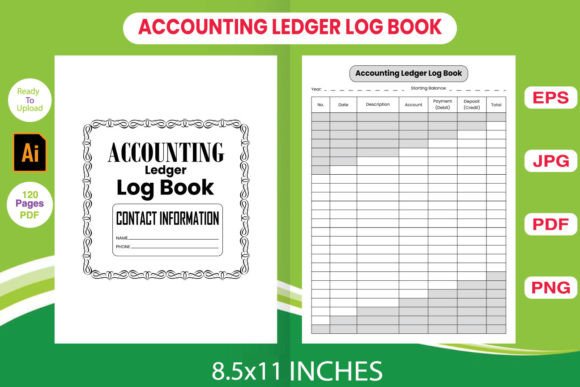
Unlike a standard eBook or novel manuscript, an accounting ledger log book interior is a structured template. It consists of pre-formatted pages with column headers for dates, descriptions, debits, credits, and balances, often including additional pages for summaries or indexes. A dedicated "Accounting Ledger Log Book KDP Interio" file is more than a simple PDF. It is usually a package of layered, editable source files alongside the final print-ready PDF. This means the core design is vector-based, created in software like Adobe Illustrator, and provided in formats such as EPS. The key distinction lies in flexibility. Because it's vector-based, you can resize the entire interior to different trim sizes without losing quality, a significant advantage over static raster images or basic PDFs.
These packages are often marketed as "KDP tested," indicating the creator has successfully uploaded the file and published a book using it, ensuring it meets Amazon's technical specifications for bleed, DPI (300 dots per inch), and margin requirements. This pre-validation can save publishers considerable time troubleshooting upload errors.
Evaluating the Complete File Package
A robust interior package goes beyond the single print PDF. When evaluating an option like an Accounting Ledger Log Book KDP Interio, you should assess the suite of files included. A typical package offers several formats, each serving a different purpose in your workflow.
- Editable EPS/AI Files: These are the source files. If you have access to vector editing software, you can modify column headings, fonts, colors, or layout structures. This is crucial if you wish to create a unique variant or adapt the template for a slightly different financial journal.
- Transparent Background PNGs: These are useful for marketing. You can use individual page images with transparent backgrounds for your Amazon listing thumbnail or promotional graphics without the white page border.
- High-Resolution JPGs: These serve as backup or alternative viewing files and can be helpful for quick previews.
- Print-Ready PDF: This is the core file you upload to KDP. It should be correctly sized (e.g., 8.5x11 inches), have no bleed settings if the design doesn't require it, and maintain 300 DPI quality throughout.
The inclusion of these multiple formats represents a tradeoff between convenience and complexity. For a publisher who simply wants to upload and sell, the PDF alone is sufficient. However, having the editable files provides a path for future customization and product line expansion, which is a strategic benefit.
Comparing Approaches: Ready-Made Interiors vs. DIY Creation
The decision to use a pre-made Accounting Ledger Log Book KDP Interio is fundamentally a choice between buying a tool and building one. Let's explore the core comparisons.
Time and Skill Investment
Creating a professional ledger interior from scratch requires graphic design skills and familiarity with publishing software like Adobe InDesign or Illustrator. It involves designing a layout, setting up master pages, formatting tables precisely, and ensuring all technical specs are met. This process can take days for a novice. A ready-made interior file eliminates this design and technical phase. You download, optionally make minor edits if you possess the skills, and upload. The time savings are substantial, allowing you to focus on marketing, cover design, and business strategy.
Cost Considerations
While purchasing an interior file has a direct cost, it often compares favorably to the indirect costs of DIY. These include the subscription fees for professional design software, the value of your time spent learning and executing, and potential opportunity costs from delayed publication. For a publisher without design expertise, the purchased file is usually more cost-effective. However, if you already own the software and have the skills, creating your own template may be cheaper per unit and gives you unlimited control and reuse potential for future projects.
Quality and Consistency
A professionally designed interior file typically offers a high, consistent standard of quality. The columns will be aligned, typography will be clean and functional, and the technical settings will be correct. A DIY project risks uneven quality—misaligned columns, poor font choices, or incorrect DPI settings—which can negatively impact the customer's experience using the ledger. The tradeoff is originality. A purchased file may be used by other publishers, whereas a custom-built interior is uniquely yours.
Key Decision Factors for Your Ledger Book Project
Determining if an Accounting Ledger Log Book KDP Interio is the right choice depends on several personal and project-specific factors.
- Your Technical Proficiency: If you are comfortable with vector editing software, an editable EPS file is a powerful asset. If you are not, ensure the package includes a print-ready PDF that perfectly matches your desired trim size.
- Your Business Model: Are you planning a single ledger book or a series? For a series, the editable files allow for quick generation of different page counts (e.g., 100, 110, 120 pages) or slight variations, making the package more valuable.
- Speed to Market: If launching quickly is a priority, a pre-tested, ready-to-upload file drastically accelerates your timeline.
- Desire for Customization: Even with an editable file, major structural changes might be complex. Consider if the base design truly fits your vision. If you need a ledger with highly specialized columns or an unconventional layout, a custom creation or a different template might be necessary.
When a Pre-Made Interior is the Optimal Fit
An Accounting Ledger Log Book KDP Interio is often the best choice for publishers who fall into specific categories. It fits the entrepreneur who is proficient in marketing and business but lacks graphic design skills. It is ideal for those testing the market with a first ledger product, wanting to minimize upfront risk and investment. It also suits publishers who value a proven, technically sound foundation and prefer to invest their effort in scaling their catalog rather than in design work.
When You Might Need Another Option
There are scenarios where a different approach may be preferable. If you are a graphic designer yourself, building your own template could be more efficient long-term. If your ledger concept is highly niche—for example, a ledger combined with budget planners or project tracking pages—a generic template may not suffice, and a custom or heavily modified interior is required. Additionally, if you are extremely budget-conscious and the file package cost is high relative to your expected royalties, exploring free template resources or simpler DIY methods using basic word processors might be a preliminary step, though often with a tradeoff in professional polish.
Beyond the File: Considering Page Count and Trim Size
Many interior packages offer the same core design in multiple page counts, like 100, 110, or 120 pages. The choice here impacts the perceived value and use-case of your final book. A 100-page ledger is suitable for short-term projects or as a compact option, while a 120-page book offers more capacity and can be marketed as a more substantial product. The standard trim size of 8.5x11 inches (US Letter) is practical and familiar, but the vector nature of good interior files means you could resize it to A4 or other sizes if your market is international. However, resizing requires the editable files and some technical adjustment to ensure margins remain correct for KDP, a factor often overlooked.
In the landscape of KDP publishing, tools like the Accounting Ledger Log Book KDP Interio represent a strategic shortcut. They convert a complex technical task into a manageable resource. By understanding the comprehensive file package, honestly assessing your own skills and needs, and comparing it to the alternative of building from scratch, you can make a pragmatic decision. This choice ultimately balances the investment of money against the investment of time and effort, aiming to find the most efficient path to a professional, marketable product that serves your customers well.