Streamlining Your Vehicle Management with a Professional Vehicle Log Book KDP Interior
Managing a vehicle, whether it's a personal car, a fleet truck, or a service van, involves a constant flow of details. From tracking maintenance to logging business mileage, the paperwork can quickly become overwhelming. This is where a professionally designed Vehicle Log Book KDP Interior becomes not just a notebook, but a central command center for all your automotive records. It's a pre-formatted, print-ready template designed specifically for Amazon KDP (Kindle Direct Publishing), allowing you to create a physical log book that is both highly functional and aesthetically polished.
The Core Purpose: Beyond Simple Note-Taking
A Vehicle Log Book KDP Interior transforms loose notes and scattered receipts into organized, authoritative data. Its primary function is to create a systematic habit of recording. Instead of scribbling oil change dates on a calendar or estimating mileage for tax purposes, you have a dedicated, structured space. This consistent logging builds a reliable history of the vehicle, which is invaluable for several real-world scenarios.
For the Individual Vehicle Owner
Consider the average car owner. They might use their Vehicle Log Book KDP Interior to meticulously track scheduled servicing, tire rotations, and battery replacements. This proactive record-keeping can significantly extend the vehicle's lifespan and prevent costly repairs. When preparing to sell the car, this comprehensive maintenance log serves as powerful proof of care, potentially increasing the resale value. It also simplifies warranty claims and discussions with mechanics, providing undeniable evidence of service history.
For Small Business Operators and Freelancers
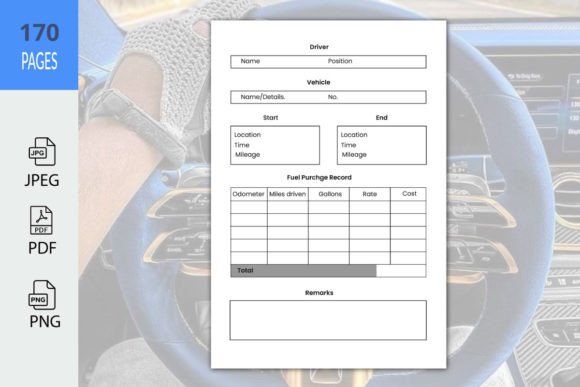
This is where the utility shines brightly. Independent contractors, realtors, delivery drivers, and tradespeople who use their vehicle for work have a critical need to separate personal and business use. A well-designed log book interior provides clear sections for daily trip logging: date, destination, purpose, start/end mileage. This data is the foundation for accurate tax deduction calculations for business mileage. It turns a tedious administrative task into a simple daily entry, safeguarding against lost deductions or issues during tax audits.
Diverse Applications Across Industries
The use of a Vehicle Log Book KDP Interior extends far beyond personal cars and small businesses.
- Fleet Management for Small Fleets: Even a small company with 2-5 vehicles can benefit. A standardized log book for each driver ensures uniform data collection on fuel consumption, maintenance needs, and driver-reported issues, facilitating better cost control and scheduling.
- Rental Vehicle Oversight: Owners who rent out vehicles on platforms like Turo can include a physical log book in the car. Renters can note any concerns or pre-existing issues, creating a transparent paper trail that protects both owner and renter.
- Vehicle Enthusiasts and Restorers: For those working on project cars or restorations, the log book becomes a journal of the build. They can track parts installed, sources, costs, and hours spent, creating a priceless narrative of the vehicle's rebirth.
- Family Vehicle Coordination: In households with multiple drivers using one car, a log book can track who drove, where, and for what purpose, helping manage responsibilities and reconcile fuel expenses.
Key Considerations Before Choosing Your Interior Template
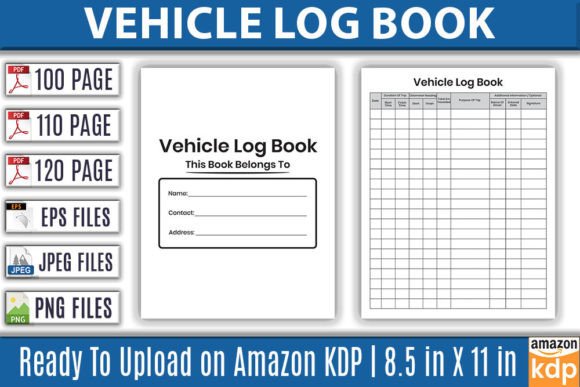
While the features like 100, 110, or 120 pages, 8.5x11 inch trim size, and tested print quality are essential, the real choice lies in matching the template's structure to your specific need. Before selecting a Vehicle Log Book KDP Interior, ask yourself a few practical questions.
- Primary Use: Is your dominant need financial (mileage for taxes) or technical (maintenance history)? Some interiors emphasize mileage logs, others have detailed mechanical service charts.
- Volume of Data: How often will you log entries? A daily driver used for business might need 120 pages for a year's records, while a weekend project car might suffice with 100.
- Collaboration Needs: Will multiple people be writing in it? If so, a design with very clear, labeled sections and ample writing space is crucial to prevent messy, overlapping entries.
- Future-Proofing: The inclusion of editable original files (EPS) and transparent PNGs is a significant advantage. It allows you, or a designer, to adapt the template later. Maybe you initially need it for personal use but later start a business—you can modify sections without starting from scratch.
The Practical Advantages of a KDP-Tested Design
The fact that a Vehicle Log Book KDP Interior is "KDP tested" and includes a print-ready PDF is a major practical benefit. It removes the technical guesswork. You aren't struggling with bleed settings, margin errors, or low-resolution graphics that print poorly. The 300 DPI quality ensures all text, lines, and any decorative elements are sharp and clear on the final printed page. This reliability means you can focus on the content and use of the book, not on troubleshooting printing issues. The bonus high-resolution JPG files also offer flexibility; they can be used for digital previews or adapted for other small-scale uses.
Observing Common User Patterns
From observing how people utilize these logs, a common pattern emerges: the first month is often meticulous, with every fill-up and trip logged. Then, the habit solidifies, and entries become quick, routine notations. The strength of a good interior is that it supports this evolution—it's intuitive enough for the detailed phase and fast enough for the routine phase. A potential limitation to acknowledge is that it's a physical tool. It requires the discipline to keep it in the vehicle or to consistently transfer data from digital notes. For users utterly reliant on smartphone apps, a hybrid approach—using the app for daily capture and the book for monthly summary and permanent record—can be highly effective.
Turning Data into Insight
Ultimately, a Vehicle Log Book KDP Interior does more than record; it helps you analyze. Over time, the collected data allows you to spot patterns. You might notice that fuel efficiency dips every certain number of miles, prompting a check on air filters or tire pressure. You can visualize your actual business travel versus personal travel, informing future budgeting or route planning. The book becomes a tangible archive of your vehicle's relationship with your life or business, providing clarity, control, and a definitive answer to the perennial question: "When did I last get this serviced?" By investing in a structured system from the start, you save countless hours of searching, guessing, and reconciling later, making vehicle management a streamlined part of your routine.