Your Guide to the Baby Food Tracker KDP Interior
You know the feeling. You’re navigating the wild and wonderful journey of starting your baby on solids, and suddenly your brain feels like a scrambled egg. Was that the third time today they tried avocado? Did they have a reaction after the sweet potato, or was it just a coincidence? When did we introduce oats? Keeping track of this culinary adventure is more than just a logistical task; it’s a piece of your child’s health story.
A Tool for the Tangible World
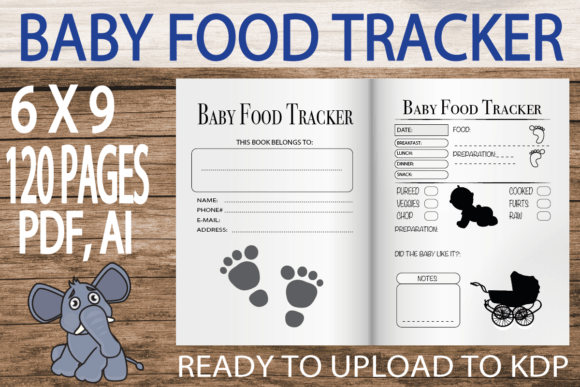
The Baby Food Tracker KDP Interior isn’t a flashy app or a complex software. It’s a practical, printable journal designed for parents who want a physical, at-hand record. Think of it as a dedicated notebook, but one that’s pre-structured with the specific prompts you need. Created for the Kindle Direct Publishing (KDP) platform, it’s a template or interior file that aspiring authors or helpful creators can use to design and publish their own customized baby food logbooks.
Who Finds This Useful? More Than Just First-Time Parents
While it’s a natural fit for new parents, the utility of a Baby Food Tracker KDP Interior stretches further. Consider the busy parent of multiples. Trying to remember which foods each twin has tolerated is a memory game no one wants to play. A simple, clear log on the kitchen counter becomes a shared reference point for both parents and any caregivers.
It’s also a fantastic resource for parents navigating specific health concerns. If your pediatrician has asked you to monitor for potential allergies or sensitivities, a tracker provides the concrete data they need: dates, foods, quantities, and observed reactions, all in one place. This isn’t just helpful for doctor visits; it gives you, the parent, a sense of control and clarity.
Beyond individual families, this concept serves a creative community. DIY-minded parents who enjoy crafting their own solutions might use a KDP Interior as a starting point to design a tracker that perfectly fits their philosophy, perhaps incorporating organic food charts or baby-led weaning milestones. Meanwhile, entrepreneurs and small publishers see it as a ready-to-use product template—they can add their own cover, adjust the layout, and sell a physical book that meets a clear market need.
Scenarios Where a Physical Tracker Wins
Imagine a typical Thursday. You’re prepping a new puree while your partner is getting ready for work. You quickly jot down “pear & spinach” in the tracker on the fridge. Later, your partner notices a slight diaper change and adds a note. No need to send a text or try to remember verbally. The book is the family’s central hub for this information.
Grandparents or babysitters stepping in for the day appreciate the simplicity. They aren’t required to download an app or navigate a digital interface. They open the book, see what was served yesterday, follow any notes, and add their own observations. It bridges the communication gap effortlessly.
For the parent who is already overwhelmed by screen time—both their own and their child’s—a paper tracker offers a tactile break. The act of writing can feel more deliberate and connected than typing into a phone. It also exists outside the digital noise, immune to battery life or notification distractions.
Considering Your Own Needs Before Choosing a Format
If you’re looking at using or buying a Baby Food Tracker KDP Interior, a few practical considerations can help. First, think about your recording style. Do you want to log every single meal, or just new introductions? Some interiors are designed for daily diary-like entries, while others focus on a chronological list of new foods.
Space is another factor. A printed book lives in your physical environment. Is your kitchen counter cluttered? Would a smaller, spiral-bound format work better? The beauty of the KDP template model is that designers can offer various sizes—from standard journals to compact pocket editions.
Also, reflect on what information is crucial for you. Beyond food and date, you might want sections for portion size, baby’s reaction (liked, disliked, allergic), meal time, or even notes on texture (puree, mashed, finger food). Scanning different available Baby Food Tracker KDP Interior designs lets you pick one that aligns with your priorities.
The Strengths of a Structured Paper System
Its primary strength is clarity and focus. It does one job exceptionally well, without the bells and whistles that can complicate digital tools. There’s no risk of accidentally deleting data, no sync issues between devices, and no subscription fee. It’s a one-time, straightforward solution.
It creates a permanent, offline record. That book becomes a keepsake. Many parents enjoy looking back at their baby’s first food adventures, a tangible memory of those early days that isn’t buried in a cloud archive. It’s a story written by hand, which often feels more personal.
For the publisher or creator, the Baby Food Tracker KDP Interior P (often indicating a “premium” or more detailed version) offers a business opportunity. By providing a well-designed, functional template, they solve a problem for other parents and build a small publishing venture with minimal upfront design cost.
Recognizing the Natural Limitations
A paper tracker, of course, isn’t for everyone. If you’re a parent who is constantly on the go and rarely home, carrying a physical book might be inconvenient compared to a quick tap on your phone. It also lacks automated reminders or data analysis—you won’t get a weekly report showing that your baby has tried five green vegetables.
It requires manual upkeep. If you forget to write in it for a few days, the record has gaps. Its success depends on your habit of using it. For some, this manual process is a welcome ritual; for others, it’s a potential point of failure.
Furthermore, if you need to share information remotely—like sending a quick update to a pediatrician or a co-parent who is traveling—you’ll need to take a photo or transcribe the notes. It doesn’t instantly digitize or share itself.
Beyond Tracking: The Unexpected Benefits
Observations from parents who use these systems often highlight secondary perks. The tracker can become a mealtime planning aid. By glancing at the last week’s entries, you can easily see which foods haven’t been offered recently, helping you rotate for variety and nutritional balance.
It also serves as a wonderful communication tool with childcare providers. Instead of a hurried verbal checklist in the morning, you can simply hand the book over with a, “Here’s what we’ve been doing.” It empowers them with context and reduces the chance of misunderstandings.
For parents feeling anxious about the introduction process, the act of logging can provide a psychological comfort. It turns a seemingly chaotic and experimental phase into a documented, manageable project. You’re not just “trying foods”; you’re “building a food history,” which can feel more organized and purposeful.
In essence, the Baby Food Tracker KDP Interior and its variants represent a return to simple, purposeful tools. They answer a modern need with an almost classic solution: a book, a pen, and a dedicated space to record a important chapter of your baby’s life. Whether you’re a parent seeking peace of mind, a caregiver wanting clear instructions, or an entrepreneur filling a niche, its value lies in its focused practicality. It doesn’t try to do everything; it aims to do one thing very well, and for many people, that’s exactly what makes it helpful.